

Quick Answer
The best water filter pitcher for most home cooks is the LifeStraw Home 10-Cup Water Filter Pitcher — The pitcher that filters like gear from an outdoor company — because it is: a membrane microfilter plus activated carbon and ion exchange that together target bacteria, parasites, microplastics, lead, and PFAS chemicals, while leaving healthy minerals in the water. On a tighter budget, the Brita Large 10-Cup Water Filter Pitcher delivers most of the same performance for less.
The best water filter pitcher depends on a question most reviews skip: what are you actually filtering out? If the answer is 'chlorine taste,' a basic Brita does the job for pennies a gallon. If it's lead, PFAS, or microplastics, you need certified multi-stage filtration — and the pitchers that deliver it cost more per fill. We compared the three 2026 pitchers that each win a different version of the question: the balanced advanced-filtration pick, the budget taste-fixer, and the maximalist that takes dissolved solids to zero and hands you the meter to prove it.
How We Picked These
For this water filter pitcher guide, we applied the framework laid out in our Editorial Policy: we evaluate materials and construction first, then weight long-term durability heavily — six-month and one-year owner-review patterns matter more than first-week impressions. We screened out products with documented reliability complaints, missing or hard-to-claim warranty support, and no-name brands without long-term service infrastructure. The picks below are the ones we'd recommend to a friend.
1. Best Overall: LifeStraw Home 10-Cup Water Filter Pitcher

LifeStraw Home 10-Cup Water Filter Pitcher
LifeStraw
- Targets PFAS, lead, microplastics, and bacteria
- Dual-stage: membrane microfilter + carbon/ion exchange
- Leaves beneficial minerals in your water
- BPA-free body in a fridge-door-friendly shape
Why we picked it: The pitcher that filters like gear from an outdoor company — because it is: a membrane microfilter plus activated carbon and ion exchange that together target bacteria, parasites, microplastics, lead, and PFAS chemicals, while leaving healthy minerals in the water.
2. Best Value: Brita Large 10-Cup Water Filter Pitcher
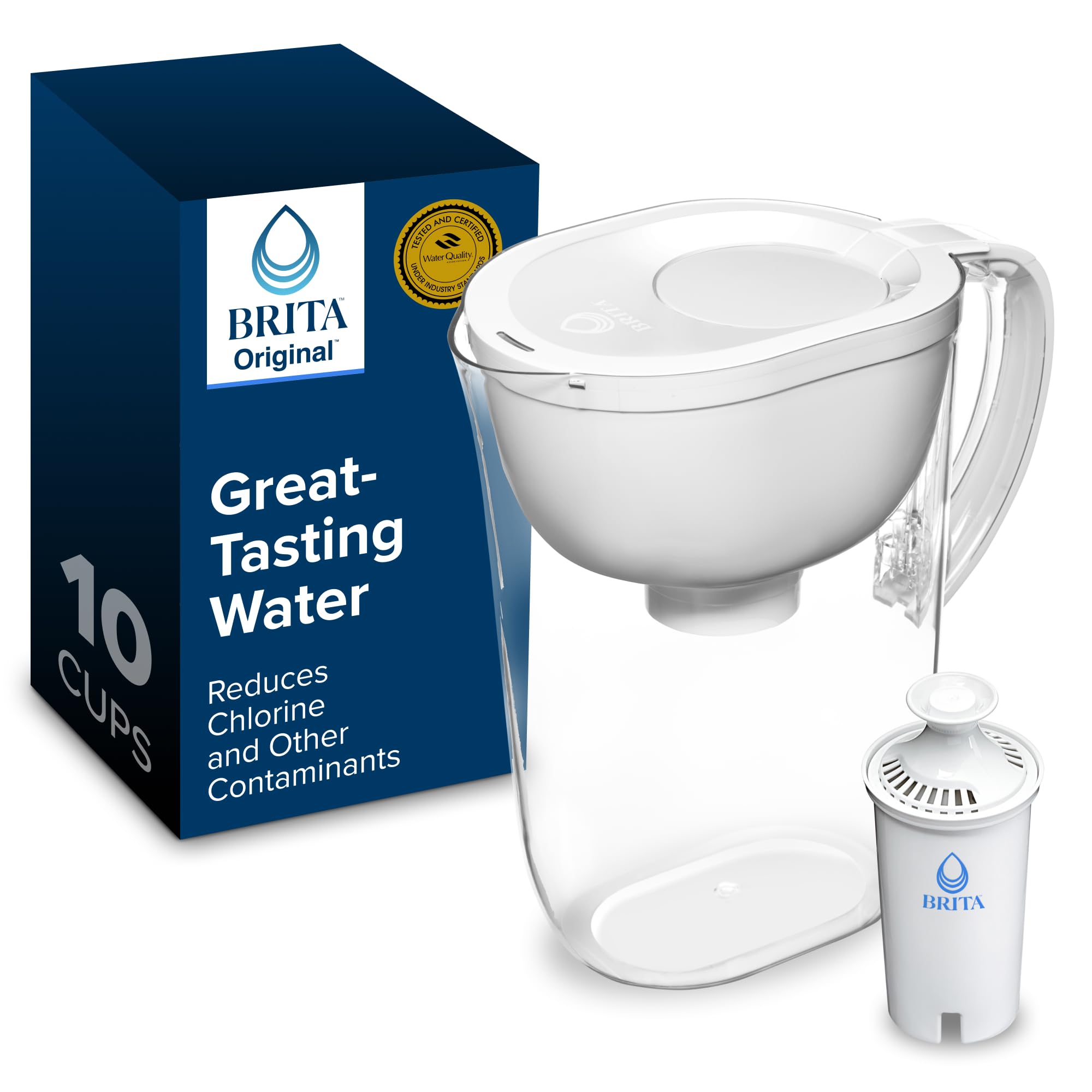
Brita Large 10-Cup Water Filter Pitcher
Brita
- Cuts chlorine taste and odor, plus mercury and cadmium
- Cheapest cost-per-gallon of the majors
- Flip-top lid for one-hand refills
- Filter-change reminder built into the lid
Why we picked it: The default water pitcher for a reason: filters are cheap, sold everywhere, and reliably fix the chlorine taste that makes people stop drinking tap water. Ten cups covers a family, and the flip-top lets you refill without removing the lid.
3. Best Premium: ZeroWater 10-Cup Ready-Pour 5-Stage Filter Pitcher

ZeroWater 10-Cup Ready-Pour 5-Stage Filter Pitcher
ZeroWater
- 5-stage filtration certified to reduce lead and chromium
- Included TDS meter shows the result in numbers
- Pour mid-filter with the sealed Ready-Pour design
- The deep-clean option for questionable tap water
Why we picked it: The pitcher for people who want proof: five stages of filtration take total dissolved solids to zero, and the included TDS meter lets you verify it from the tap. The Ready-Pour lid means you can pour while the top reservoir is still filtering.
The Comparison Table
| Pick | Brand | Product | Key spec |
|---|---|---|---|
| Best Overall | LifeStraw | LifeStraw Home 10-Cup Water Filter Pitcher | Targets PFAS, lead, microplastics, and bacteria |
| Best Value | Brita | Brita Large 10-Cup Water Filter Pitcher | Cuts chlorine taste and odor, plus mercury and cadmium |
| Best Premium | ZeroWater | ZeroWater 10-Cup Ready-Pour 5-Stage Filter Pitcher | 5-stage filtration certified to reduce lead and chromium |
What to Look For
Read the certification list, not the marketing. A pitcher can say 'removes 99% of contaminants' while being certified only for chlorine and zinc. Look for NSF/ANSI 42 (taste and odor), 53 (health contaminants like lead), and 401 (emerging compounds — pharmaceuticals, some PFAS). The three pitchers here publish real certification lists; many Amazon-brand pitchers do not, and that absence is the answer.
Filter cost per gallon is the real price. The pitcher is a one-time $25-45; the filters are forever. Brita's run cheapest per gallon, LifeStraw's membrane lasts a year (with the carbon stage swapping every two months), and ZeroWater's cost scales with how dissolved-solid-heavy your tap water is — hard-water households burn through them faster. Check your municipal water report before choosing a filtration tier you may not need.
Filtration speed and reservoir design shape daily use. Five-stage filters pour slowly — that's the physics of doing more. ZeroWater's Ready-Pour design lets you pour while the top tank is still filtering; LifeStraw's dual-stage runs faster than its capability suggests; Brita is the quickest of the three. If the pitcher will live in a fridge door, measure the door shelf first.
Which water filter pitcher matches your actual tap water
Start with your city's annual water quality report (search your utility's name + 'consumer confidence report' — it's free and mandatory). Municipal water that's safe but tastes like a swimming pool: Brita, done, savings pocketed. Older housing stock with possible lead service lines, or a region with known PFAS contamination: the LifeStraw Home's certification list covers exactly that threat profile while keeping healthy minerals in the water. Well water or high total-dissolved-solids readings: ZeroWater's five stages are built for the heavy-duty case, and its TDS meter turns an invisible question into a number.
The pitcher is also the gateway upgrade for everything water touches in the kitchen: coffee gear especially. Chlorinated water flattens coffee flavor and scales up machines — our drip machine and descaling guide both assume filtered water as step one. Same logic for the electric kettle that feeds your tea.
Getting honest performance from any filter pitcher
Three habits keep a filter pitcher performing at spec. Change filters on schedule — an exhausted carbon filter doesn't just stop working, it can shed accumulated load back into the water; set a recurring phone reminder because the little lid stickers fail everyone. Refrigerate the pitcher: carbon-filtered water has no chlorine residual, so treat it like a fresh food product, consumed within a day or two. And wash the pitcher body weekly with soap — the reservoir grows biofilm like any container that stays wet, and a slimy reservoir undoes the filter's work downstream.
Flush new filters per the manual (usually two or three discard fills) to clear loose carbon fines — the gray dust in your first pour is harmless but unappetizing. If your household drains more than a pitcher a day, consider running two in rotation: one filtering, one cold and full. For hydration downstream of the pitcher, our water bottle and tumbler roundups keep it cold all day.
Buyer Scenario Decision Matrix
Stop comparing specs. Start with what you're actually doing, then the right product is obvious:
| Your Situation | Buy This | Skip This | Why |
|---|---|---|---|
| Most people — daily use, no compromises | LifeStraw Home 10-Cup Water Filter Pitcher | Premium-only sets you won't grow into | Targets PFAS, lead, microplastics, and bacteria |
| Budget-conscious or first-time buyer | Brita Large 10-Cup Water Filter Pitcher | Premium upgrade you may not need yet | Cuts chlorine taste and odor, plus mercury and cadmium |
| Heavy daily use, splurge, or buy-once-keep-forever | ZeroWater 10-Cup Ready-Pour 5-Stage Filter Pitcher | Cheaper sets — you'll outgrow them | 5-stage filtration certified to reduce lead and chromium |
Bottom Line: Which Should You Buy?
For most people: the LifeStraw Home 10-Cup Water Filter Pitcher. The pitcher that filters like gear from an outdoor company — because it is: a membrane microfilter plus activated carbon and ion exchange that together target bacteria, parasites, microplastics, lead, and PFAS chemicals, while leaving healthy minerals in the water.
On a budget: the Brita Large 10-Cup Water Filter Pitcher. The default water pitcher for a reason: filters are cheap, sold everywhere, and reliably fix the chlorine taste that makes people stop drinking tap water. Ten cups covers a family, and the flip-top lets you refill without removing the lid.
Worth the splurge: the ZeroWater 10-Cup Ready-Pour 5-Stage Filter Pitcher. The pitcher for people who want proof: five stages of filtration take total dissolved solids to zero, and the included TDS meter lets you verify it from the tap. The Ready-Pour lid means you can pour while the top reservoir is still filtering.
Ready to buy?
Jump straight to our top picks on Amazon — prices shown at click-through.
Frequently Asked Questions
What is the best water filter pitcher for lead?
Look for NSF/ANSI 53 lead certification specifically — the LifeStraw Home and ZeroWater 5-stage both carry it; standard-filter Brita pitchers need the Elite filter upgrade for lead claims. If lead is a known concern, also run the tap cold for 30 seconds before filling and consider a certified faucet filter as a second layer.
Do water filter pitchers remove PFAS?
Only some. Activated carbon reduces certain PFAS compounds, but reduction varies by pitcher and filter age. LifeStraw's Home pitcher publishes PFAS reduction claims (PFOA/PFOS); basic taste-focused filters don't. For confirmed PFAS contamination, a certified reverse-osmosis system outperforms any pitcher.
How often should you change a water filter pitcher filter?
Brita standard: about 40 gallons or 2 months. LifeStraw Home: carbon/ion stage every ~2 months, membrane microfilter once a year. ZeroWater: whenever the included TDS meter reads 006 — which arrives faster in hard-water areas. Overdue filters filter less and can harbor bacteria.
Is filtered pitcher water better than bottled water?
For most municipal taps, filtered water matches or beats bottled on taste and testing transparency at roughly 2-5% of the cost — and without the microplastic and waste questions bottled carries. Bottled earns its place mainly for emergencies and travel.
What is the top-rated water filter pitcher for 2026?
Our top-rated pick is the LifeStraw Home 10-Cup Water Filter Pitcher. The pitcher that filters like gear from an outdoor company — because it is: a membrane microfilter plus activated carbon and ion exchange that together target bacteria, parasites, microplastics, lead, and PFAS chemicals, while leaving healthy minerals in the water.
Which water filter pitcher is best for beginners or a tighter budget?
The best-rated value pick is the Brita Large 10-Cup Water Filter Pitcher — The default water pitcher for a reason: filters are cheap, sold everywhere, and reliably fix the chlorine taste that makes people stop drinking tap water. Ten cups covers a family, and the flip-top lets you refill without removing the lid.
Are glass water filter pitchers better than plastic?
Functionally the filtration is identical — the filter cartridge does the work. Glass avoids plastic contact for taste-sensitive users, looks better on a table, and doesn't cloud with age, at the cost of weight and drop risk. LifeStraw and Brita both offer glass or premium variants.
Why is my water filter pitcher slow?
Either the filter is exhausted (most common — replace it), the filter wasn't fully flushed and air is locked in the cartridge (soak and tap it underwater), or your water is high in sediment, which clogs filters early. Five-stage pitchers like ZeroWater are also simply slower by design — more stages, more time.
Want to dig deeper? See our guides to Best Insulated Water Bottle (2026), Best Electric Kettle (2026), Best Tea Kettle (2026), and Best Tumbler (2026).