
“Is ceramic cookware safe?” is one of the most common kitchen questions, and the short answer is reassuring: reputable ceramic cookware is considered safe for everyday cooking, and it's specifically free of the PTFE and PFAS chemistry that drives most nonstick worry. The nuances worth understanding are which brand you buy and how long you keep cooking on a worn-out pan. Here's the plain-English version.
What you need to know
“Ceramic” nonstick isn't solid ceramic
Almost all “ceramic” cookware is a thin, silica-based (sol-gel) mineral coating bonded over an aluminum or hard-anodized body — not a solid fired-ceramic pan like an Xtrema. Both forms are generally considered safe to cook on; the coated kind is just lighter, slicker, and far more common. Knowing the difference helps you read the marketing honestly.
It's free of PTFE, PFOA, and PFAS
The main safety appeal is what ceramic coatings leave out: no PTFE (Teflon-type fluoropolymer), no PFOA, and no PFAS. That means the classic nonstick concern — fumes from an empty PTFE pan overheated past ~500°F — doesn't apply the same way. Reputable ceramic is inert at normal cooking temperatures.
Lead and cadmium: buy reputable brands
The real safety variable is manufacturing quality. Established brands (the kind featured here) formulate their coatings free of lead and cadmium and test for it. The documented risk cases come from cheap, unbranded imports and decorative glazed ceramics not meant for cooking. Buying a recognized cookware brand all but removes this concern.
The real issue is a worn-out coating
Ceramic nonstick degrades faster than PTFE — typically one to three years of regular use. A dull or lightly scratched coating isn't a major toxicity hazard, but once it stops releasing food or starts to flake, the pan has reached the end of its useful life. The honest guidance is to replace ceramic pans when the nonstick fails rather than cooking on a visibly degraded surface.
How to use it safely and make it last
Cook on low-to-medium heat, never use aerosol cooking spray (it bakes into a film that wrecks the coating), avoid metal utensils, hand-wash instead of using the dishwasher, and never preheat an empty pan. These habits both protect the coating and keep the pan performing the way it should — the safest ceramic pan is a well-maintained one you replace when it wears out.
Recommended Gear
The gear we'd reach for. Prices shown on Amazon at click-through.
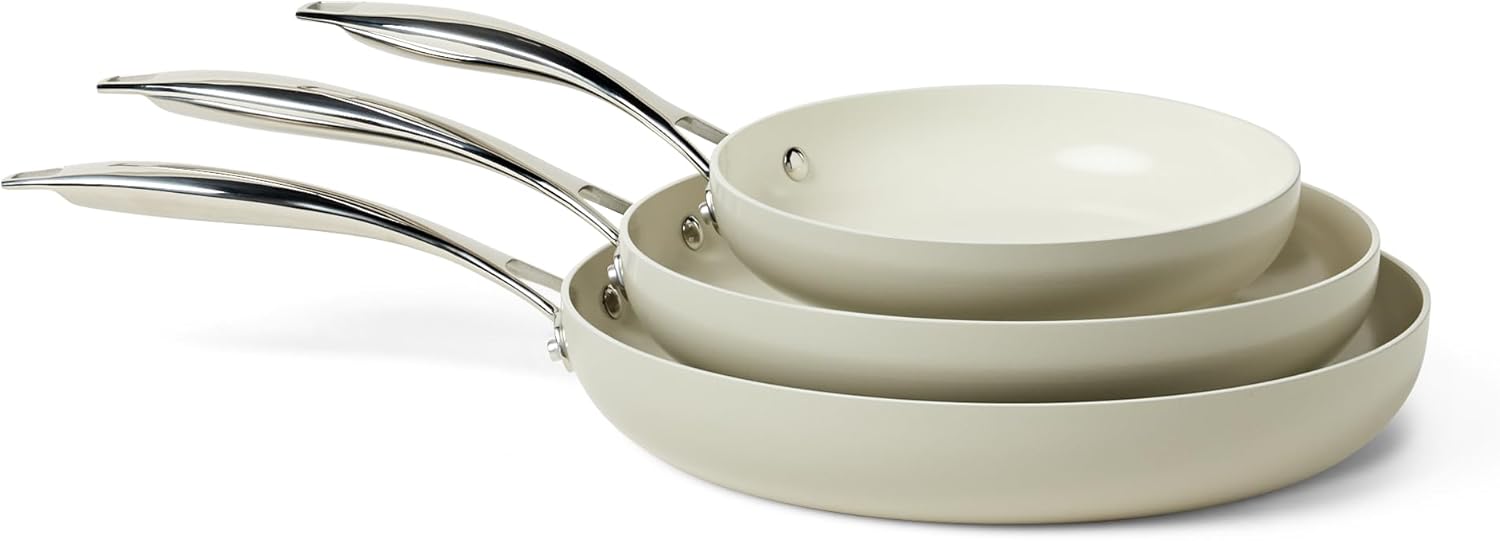
Amazon Basics Ceramic Nonstick 3-Piece Frying Pan Set
budget-friendly
An inexpensive way to skip fluoropolymers entirely — a PFAS-free ceramic fry-pan trio that's an easy, low-risk starting point.
Check Price on Amazon →
GreenPan Valencia Pro Ceramic Nonstick 3-Piece Fry Pan Set
premium tier
GreenPan's Thermolon ceramic is PFAS-free, hard-anodized for durability, and oven-safe to 600°F — a sturdier ceramic pick from an established brand.
Check Price on Amazon →What the coating is made of, and why it goes from slick to sticky
Understanding why ceramic nonstick fails explains most of the safety conversation. A sol-gel coating starts as a liquid silica-based solution sprayed onto the pan and cured at high heat into a hard, glass-like mineral layer. That layer is genuinely inert — it's closer to glass than to a plastic — but a glassy surface is not especially nonstick on its own. The release you get out of the box comes largely from silicone-type oils and polymers infused into the microscopic pores of the coating during manufacturing. Every heating cycle drives a little of that off, and every layer of cooked-on fat that polymerizes onto the surface fills the pores with something sticky instead. That is the real reason a ceramic pan's release fades in one to three years while the coating itself looks intact: the mineral layer is still there, the slickness is not.
Two practical conclusions follow. First, the sticking that arrives after a year or two is usually a build-up problem before it's a wear problem — a soak in hot water and baking soda, followed by a gentle scrub, restores a surprising amount of release on a pan that has been "seasoned" with polymerized oil. Second, high heat is the thing that shortens the pan's life fastest, because it both bakes oil onto the surface and drives off the release agents. Nothing hazardous is being generated in that process at normal stovetop temperatures; the cost is performance, not safety. If you want the science of how this compares to the fluoropolymer alternative, our nonstick safety explainer and stainless vs ceramic comparison cover the trade-offs without the marketing.
Reading the labels: "ceramic," "PFAS-free," and the certifications that actually mean something
"Ceramic" is not a regulated term in cookware, and that is the honest core of the safety question. Anything with a mineral-based sol-gel coating can be called ceramic, as can pans whose marketing leans on "titanium," "diamond," or "granite" — those are usually additives suspended in a sol-gel or, occasionally, in a conventional PTFE base. A pan that says only "PFOA-free" is telling you very little, since PFOA has been phased out of cookware manufacturing for years; the claim you want is "PFAS-free" or "no PTFE," which rules out the whole fluoropolymer family. Reputable brands say it plainly. Vague language is itself a signal.
Beyond the claims, look for third-party frameworks. In the US, coatings must comply with FDA food-contact regulations, and California's Proposition 65 requires a warning if a product can expose users to listed chemicals above a threshold — so a ceramic pan sold without a Prop 65 warning is at least asserting it clears that bar. European LFGB certification (a German food-contact standard) is stricter and is the one serious brands cite for heavy-metal migration testing. Independent lab testing published by consumer groups has occasionally found fluorine in coatings marketed as ceramic, which is exactly why brand reputation, not the word on the box, is the variable that matters. The picks in our ceramic cookware roundup and non-toxic cookware guide are chosen with that in mind; the Caraway vs Our Place comparison shows how two well-known ceramic brands differ in exactly these details.
Edge cases: worn-through coatings, glazed pottery, and solid ceramic
The scenario that deserves a clear answer is a ceramic coating worn all the way through to the aluminum underneath, which shows as dull gray patches in the center of the pan. Aluminum is not dangerous to cook on in the way lead is — countless restaurants cook on bare aluminum — but exposed aluminum does react with acidic foods like tomato sauce and wine, picking up a metallic taste and dulling the pan, and a coating worn to bare metal has no release left anyway. Treat bare-metal patches as the end of the pan's life for practical reasons. Chips at the rim or a few surface scratches are cosmetic; the fragments are inert mineral, not the concern people imagine.
Solid ceramic and glazed stoneware are a different category with a different risk profile. Pans and bakers fired from clay, like Xtrema or an enameled Dutch oven, contain no coating to wear off, and from an established manufacturer they are among the safest cooking surfaces available; our enameled cast iron safety guide covers the glaze question for that material. The genuine lead hazard lives in decorative, artisanal, antique, and imported glazed pottery never intended for cooking or never tested — brightly colored low-fire glazes, especially on pieces from markets and souvenir shops, can leach lead into acidic food. If a glazed piece has no manufacturer's food-safe declaration, use it for display. Inexpensive lead test swabs sold at hardware stores give a quick answer for a beloved heirloom, and the FDA's guidance is simple: when in doubt, don't cook or store food in it.
Frequently Asked Questions
Is ceramic cookware safe to cook with every day?
Yes — reputable ceramic cookware is considered safe for daily cooking. It's free of PTFE, PFOA, and PFAS, and recognized brands test free of lead and cadmium. Use low-to-medium heat and replace the pan once the coating wears out.
Is ceramic cookware safer than Teflon?
Ceramic avoids fluoropolymer chemistry (PTFE/PFAS) entirely, which is why many buyers prefer it. Modern PTFE is PFOA-free and considered safe below about 500°F, but ceramic sidesteps that concern — at the cost of a shorter lifespan.
Is it safe to use a ceramic pan with the coating worn through to the metal?
It isn't dangerous the way lead would be — the exposed aluminum underneath is the same metal restaurants cook on — but it's the end of the pan's useful life. Bare aluminum reacts with acidic foods like tomato sauce, picks up a metallic taste, and has no release left. Treat gray worn-through patches as the replacement signal.
What temperature is ceramic cookware safe to?
The mineral coating itself is stable well above normal cooking temperatures, and most ceramic pans are rated oven-safe to 400-600°F depending on the handle and body. The practical limit is lower: sustained high heat drives off the release agents that make the pan nonstick and bakes oil onto the surface, so cook on medium and below to keep the pan working.
Want to dig deeper? See our guides to Best Ceramic Cookware (2026), Best Non-Toxic Cookware (2026), and Are Nonstick Pans Safe?.