

Quick Answer
Hone every use, sharpen every 6 months for typical home cooks. Daily cooks: every 2-4 months. The product we'd reach for: SHARPAL Pull-Through Knife Sharpener.
Hone every use, sharpen every 6 months for typical home cooks. Daily cooks: every 2-4 months. Pros: monthly. The real test isn't a calendar — it's the knife's behavior. If it can't cleanly slice a ripe tomato or shave paper, sharpen.
How We Researched This
For this guide, we cross-referenced manufacturer documentation, expert cooking sources, and aggregated user experience reports to identify the underlying cause and the highest-success-rate fixes. Where we recommend products to help, they're tools we'd actually use ourselves and that earn consistent praise from owners six-plus months into ownership — not first-impression picks. See our Editorial Policy for the full framework.
1. Best Overall: SHARPAL Pull-Through Knife Sharpener

SHARPAL Pull-Through Knife Sharpener
SHARPAL
- 3-stage sharpening
- Easy to use
- Tungsten + diamond
- Non-slip base
Why we picked it: Easy pull-through sharpener for monthly maintenance on budget knives.
2. Best Value: Work Sharp Culinary E2

Work Sharp Culinary E2
Work Sharp
- Electric
- Multi-stage
- Premium build
- Work Sharp brand
Why we picked it: Premium Work Sharp electric sharpener — pro results at home.
3. Best Premium: Wüsthof Handheld Knife Sharpener
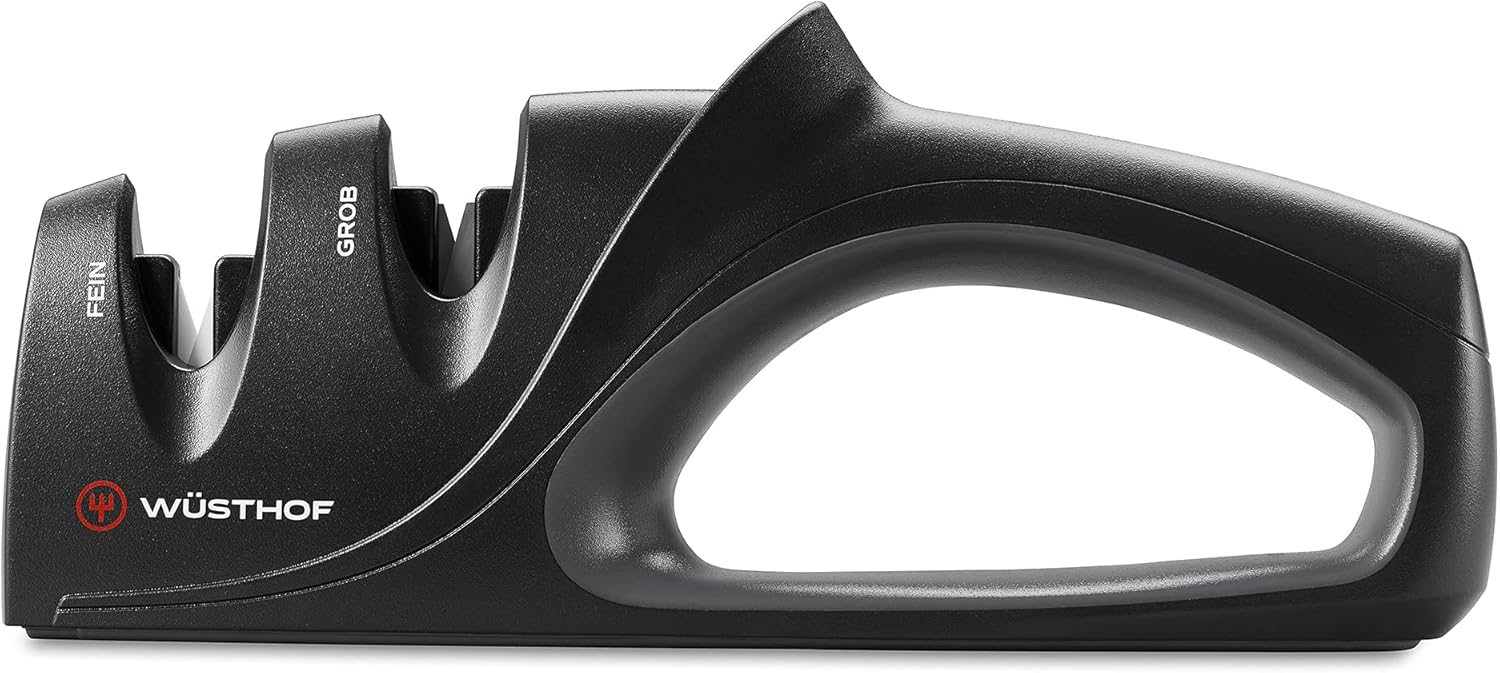
Wüsthof Handheld Knife Sharpener
Wüsthof
- Wüsthof brand
- 2-stage
- Comfortable grip
- Travel-friendly
Why we picked it: Wüsthof's own handheld sharpener — perfect for German knives.
The Comparison Table
| Pick | Brand | Product | Key spec |
|---|---|---|---|
| Best Overall | SHARPAL | SHARPAL Pull-Through Knife Sharpener | 3-stage sharpening |
| Best Value | Work Sharp | Work Sharp Culinary E2 | Electric |
| Best Premium | Wüsthof | Wüsthof Handheld Knife Sharpener | Wüsthof brand |
What to Look For
Honing ≠ sharpening. Honing realigns the edge (a 5-second pass on a steel rod before each use). Sharpening removes metal to create a new edge (every few months). Most home cooks only need to hone — the edge stays effectively sharp for half a year.
Test before sharpening. The paper test: a sharp knife slices through printer paper cleanly with one downward stroke. A dull knife tears or won't cut. The tomato test: a sharp knife glides through skin with zero pressure. If your knife passes both, don't sharpen yet.
The variables that stretch or shrink the interval: steel, board, and what you cut
The six-month rule is an average across wildly different kitchens, and four variables move a given knife well off it. The first is steel hardness. German-style knives from Wüsthof or Henckels run around 56-58 on the Rockwell scale: tough, slightly softer, and quick to roll their edge, so they respond to frequent honing and need sharpening on the shorter side of the range. Japanese knives at 60-63 HRC hold an edge two or three times longer but don't roll — they chip — so honing does less for them and sharpening is a less frequent but more careful job. The Henckels vs Wüsthof and Wüsthof vs Shun comparisons show that difference in practice.
The second variable is the board. Glass, granite, ceramic, and stone boards dull a knife faster than any amount of cutting; bamboo is harder than it looks and does the same at a slower rate. End-grain wood and soft plastic are kindest, and switching boards can double the time between sharpenings — see the cutting board guide for which materials matter. The third is the work itself: bones, frozen food, hard squash, and acidic ingredients like citrus and tomatoes (acid etches a fine edge over time) all shorten the interval, while a knife that mostly slices onions and herbs can go a year. The fourth is everything that happens when the knife isn't cutting: dishwashers rattle a blade against racks and cutlery, a drawer full of loose tools nicks the edge nightly, and both are why a knife that is honed daily still tests dull at three months. A block, magnetic strip, or in-drawer tray, as in our storage guide, is a sharpening-frequency decision as much as an organizing one.
Honing rods are not all the same, and honing has a limit
Since honing is what you'll do far more often than sharpening, the rod matters. A traditional grooved steel rod realigns a rolled edge on softer German knives and removes essentially no metal — the right daily tool for those knives. A ceramic rod is slightly abrasive: it realigns and lightly polishes, which suits harder Japanese steel that a steel rod can chip, and it extends the interval between true sharpenings. A diamond-coated rod is a sharpener in disguise; it removes metal on every stroke, and using it daily is the over-sharpening the page warns about. If you own one, treat it as a monthly touch-up tool, not a habit. Whichever rod, technique is light pressure and a consistent angle of about 15-20 degrees, a few alternating strokes per side — the dramatic television flurry is both unnecessary and how people chip an edge.
Honing has a ceiling. A rolled edge can only be stood back up so many times before the thin metal at the apex fatigues and breaks off, and at that point the knife feels dull immediately after honing, or improves for a day and fades. That's the real "time to sharpen" signal, more reliable than the calendar: when honing stops restoring the edge, the edge is gone. The other tell is the paper test failing in specific spots rather than along the whole blade, which indicates microchips from the board or a bone. Stropping on leather or a loaded strop is a third option between honing and sharpening that many home cooks never try; it polishes the apex and can add weeks to a Japanese knife's edge. For the sharpening itself, the whetstone guide and no-stone methods cover the how.
Method changes the math: little and often versus a lot, rarely
How much metal a sharpening removes depends on the tool, and that changes how often you can afford to do it. Pull-through sharpeners with carbide or diamond stages scrape off a lot of steel quickly and leave a coarse, toothy edge; they're convenient, and they're the reason a cheap knife sharpened monthly on one gets visibly narrower in a few years. Electric sharpeners like the Work Sharp are more controlled but still remove more than a stone. A whetstone is the least aggressive and the most precise — a few minutes on a medium-fine stone (1000-3000 grit) takes off almost nothing and restores a keen edge, which is why many experienced cooks flip the schedule: a light stone touch-up every few weeks instead of a heavy regrind twice a year. That approach removes less total metal, keeps the knife sharper on average, and largely eliminates the dull weeks before a scheduled sharpening. The whetstone roundup and sharpener guide lay out which tools sit where on that spectrum.
Edge angle is the other piece of the math. German knives are typically ground to 20 degrees per side, Japanese knives to 12-16, and matching the sharpener to the knife matters: forcing a 15-degree Japanese edge through a 20-degree pull-through slot regrinds the whole bevel every time and wastes a lot of steel. Serrated knives are the exception to every rule here — the scallops keep cutting long after a plain edge would be dull, they can't be honed, and they need a ceramic rod or tapered sharpening file worked scallop by scallop, roughly once a year or two. Most people replace a bread knife rather than sharpen it, which is reasonable. Finally, a professional sharpening service once a year, with honing and a light stone touch-up in between, is a legitimate strategy for a household that doesn't want to learn stones; the cost is small, and a pro removes less metal than an enthusiastic beginner.
Buyer Scenario Decision Matrix
Stop comparing specs. Start with what you're actually doing, then the right product is obvious:
| Your Situation | Buy This | Skip This | Why |
|---|---|---|---|
| Most people — daily use, no compromises | SHARPAL Pull-Through Knife Sharpener | Premium-only sets you won't grow into | 3-stage sharpening |
| Budget-conscious or first-time buyer | Work Sharp Culinary E2 | Premium upgrade you may not need yet | Electric |
| Heavy daily use, splurge, or buy-once-keep-forever | Wüsthof Handheld Knife Sharpener | Cheaper sets — you'll outgrow them | Wüsthof brand |
Recommended Products
What we'd reach for: the SHARPAL Pull-Through Knife Sharpener. Easy pull-through sharpener for monthly maintenance on budget knives.
Budget alternative: the Work Sharp Culinary E2. Premium Work Sharp electric sharpener — pro results at home.
If you want the upgrade: the Wüsthof Handheld Knife Sharpener. Wüsthof's own handheld sharpener — perfect for German knives.
Ready to buy?
Jump straight to our top picks on Amazon — prices shown at click-through.
Frequently Asked Questions
How do you know when a knife needs sharpening?
Use the paper or tomato test. If the knife can slice paper cleanly with one stroke and glides through tomato skin with no pressure, it's still sharp. If it tears paper or crushes tomato, time to sharpen.
Can you sharpen a knife too often?
Yes — every sharpening removes a tiny amount of metal. Over-sharpening shortens knife life by a decade. Hone weekly, sharpen quarterly maximum. Most home cooks over-sharpen.
What's the best product to fix this?
We'd reach for the SHARPAL Pull-Through Knife Sharpener. Easy pull-through sharpener for monthly maintenance on budget knives.
How long does this take to fix?
Most solutions are 10-30 minutes of active work. Prevention takes 30 seconds per use.
Do Japanese knives need sharpening more or less often than German knives?
Less often, but more carefully. Japanese knives at 60-63 HRC hold an edge two or three times longer than 56-58 HRC German steel, but their harder edge chips instead of rolling, so honing does little for them and a steel rod can damage them. Use a ceramic rod or strop between sharpenings, and sharpen on a whetstone at the knife's 12-16 degree angle.
Should you sharpen a serrated bread knife?
Rarely. The scallops keep cutting long after a plain edge dulls, and they can't be honed. When one finally tears bread instead of slicing, work a ceramic rod or tapered sharpening file through each scallop on the beveled side, then lightly wipe the burr off the flat side. Most people replace a bread knife every several years instead, which is a reasonable choice.
Want to dig deeper? See our guides to Best Chef's Knife (2026), Best Knife Set (2026), and How to Sharpen a Knife Without a Stone.